TURBO ZNO
The design function behind an online school's growth — a visual system, reusable templates, and a request workflow that carried around twelve simultaneous product launches.
Context
TURBO ZNO is an online school preparing students for Ukraine’s national exams — a market where trust is everything and the buying decision is usually made by parents. I worked there as Art Director & Graphic Designer from 2022 to 2024. When I arrived, design was produced ad hoc: every launch looked a little different, every marketer briefed designers differently, and quality depended on who happened to be free. My job was to replace that improvisation with a design function — a visual system, a template library, and a workflow that could carry the school’s pace without me personally touching every asset.
The stakes were commercial, not decorative. An online school launches constantly: new courses, new intakes, new campaigns, new exam seasons. Each launch needs landing views, creatives, social assets, and educational materials, all recognisably from the same school and all ready on time. Design here is infrastructure — invisible when it works, a bottleneck for the whole company when it does not.
Problem
The school had three linked problems. First, there was no central visual language, so marketing output drifted: the website said one thing, social creatives said another, and course materials said a third. For parents comparing schools, inconsistency reads as unreliability. Second, there was no reuse — each launch started near zero, which made the design team the slowest part of every launch plan. Third, there was no stable briefing process: rotating teams of SMM specialists and marketers each requested work in their own way, with shifting deadlines and informal approvals, so designers spent as much time decoding requests as fulfilling them.
Underneath all three sat a scaling problem. A single talented designer can carry a school through a few launches. Around twelve simultaneous product launches — the pace the school operated at — no individual can carry, no matter how fast. The only way through is systems: templates other people can use, rules other people can follow, and a workflow that survives staff rotation.
Role
I established and led the school’s design function. I started as the hands-on lead designer, personally producing approximately fifty to sixty percent of design output, and expanded from there into directing the broader team. That sequence mattered: because I had produced the work myself, the systems I built afterwards were grounded in real production pain rather than theory. I defined the visual system used across websites, marketing, educational products, and communications, and I led the design function during the school’s growth to seven-figure turnover between 2022 and 2024.
Process
The visual system came first. I defined a central language — type, colour, composition rules, and component patterns — that could stretch from a high-energy campaign creative to a calm course page without breaking. The energy was deliberate: exam preparation is stressful, and the brand’s confidence is part of what it sells to parents. But energy without rules is noise, so every expressive element got boundaries: where the bold type goes, where it never goes, how photography and graphics combine, how a course card looks whether it appears on the website, in an email, or in a social post.
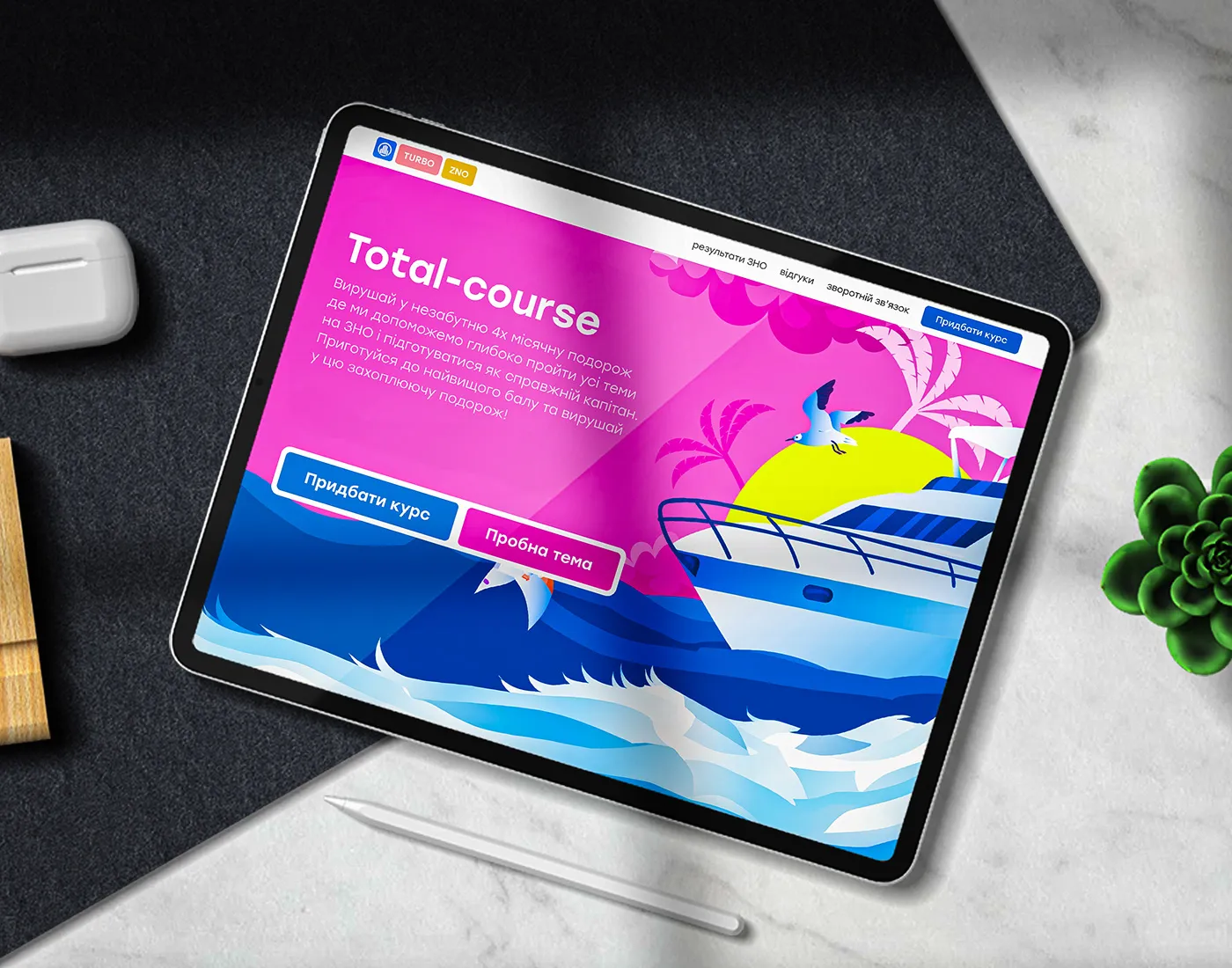
The website was the system’s anchor. I designed a responsive school site organised around two visitor jobs: course discovery and enrolment. Course browsing had to be clear enough for a teenager and convincing enough for the parent paying — which meant honest structure (what the course covers, how it is taught, what it costs, how to join) carried by confident branding rather than buried under it. Enrolment paths were kept simple and visible, because every extra step in school signup loses families to competitors.
Then came reuse. I built template systems for the recurring assets — launch creatives, course materials, social formats — that designers, SMM specialists, marketers, and educational staff could all work with. The templates encoded the visual system’s decisions so that non-designers could produce on-brand output without a designer reviewing every file. This is the part of the work I am proudest of: design that keeps working when the designer leaves the room.
Finally, the workflow. I designed a structured creative-request process that standardised briefs, deadlines, approvals, and task tracking between rotating marketing teams and designers. Standard formats replaced ad-hoc messages; approval steps replaced corridor decisions. It sounds bureaucratic, but it did the opposite of slowing people down — by removing ambiguity about who needs what by when, it freed both sides to spend their time on the work instead of on coordinating the work.
Outcome
I led the design function during the school’s growth to seven-figure turnover between 2022 and 2024. That sentence describes the period and my role in it; the turnover belongs to the whole company’s effort, and I claim only my part — that design stopped being the bottleneck and became infrastructure the launches could rely on. The concrete, checkable facts are the systems: reusable templates in daily use across approximately twelve simultaneous product launches, and a request workflow that kept rotating teams and designers aligned. The school website concept is public in a gallery for anyone who wants to judge the visual direction directly.
Deliverables
- A central visual language covering websites, marketing, educational products, and communications
- A responsive online-school website with clear course discovery and simple enrolment paths
- Reusable design systems and templates used across approximately twelve simultaneous product launches
- Template formats usable by designers, SMM specialists, marketers, and educational staff
- A structured creative-request workflow standardising briefs, deadlines, approvals, and tracking
- Public gallery of the school website concept
Outcome
Design function behind growth to seven-figure turnover; templates across ~12 simultaneous launches
Back to Brand and design systemsHave a similar project?
Pricing is on request. Send a few lines about what you need and when, and I will reply with next steps.
Write to hello@mykhailo.site