Soily
Product validation, identity, website, and pitch for Soily.World — the early-stage ag-tech platform that entered the Tehnopol Startup Incubator and the sTARTUp Day Top 25.
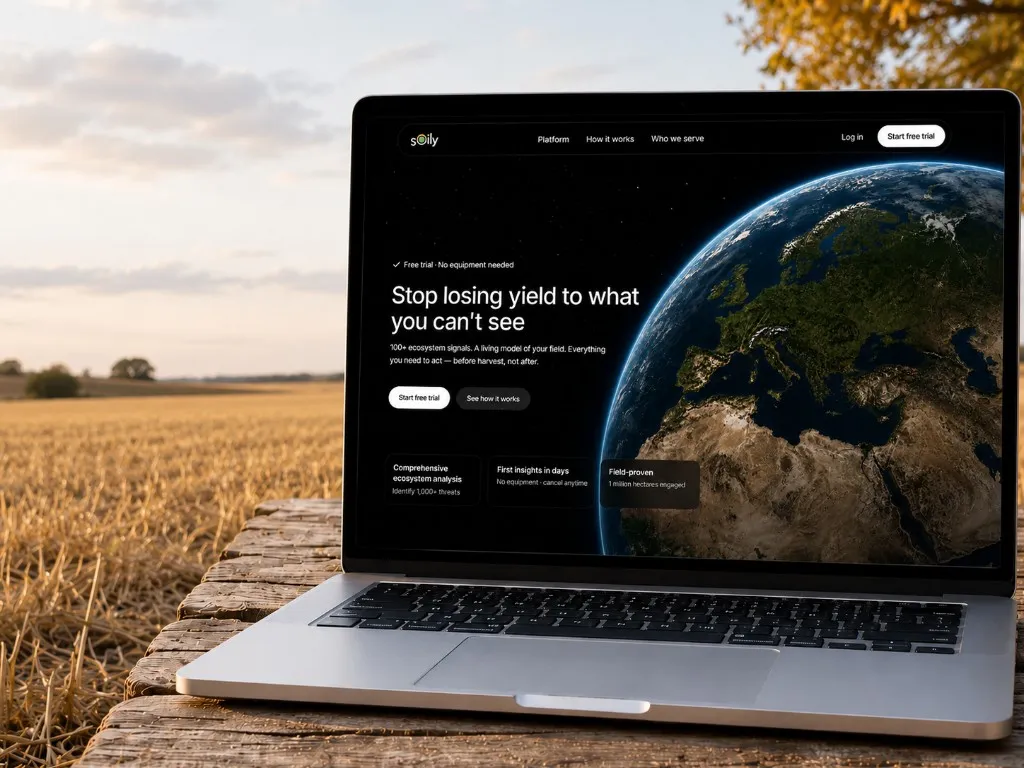
Context
Soily.World is an early-stage ag-tech company building a land intelligence platform — software that turns satellite, soil, and crop signals into a living model of the field, so farmers can act before harvest instead of after. I joined as Digital Design & External Relations Lead in 2024, which meant owning two things at once: the product and identity side (discovery, UX, visual design, website) and the outward side (investor materials, pitches, partnership communication). At an early-stage startup those two jobs are really one job — the company’s credibility with users and its credibility with investors are built from the same evidence.
The context is the Tallinn and Tartu startup ecosystem: Tehnopol Startup Incubator, Tartu Science Park growth programmes, and the sTARTUp Day stage. For a pre-seed company with no in-house designer, looking investable and launch-ready is not vanity — it is the precondition for conversations with incubators, investors, and first partners. My brief was to make Soily look like the company it was becoming, while doing the research and validation work that made that look honest.
Problem
Early-stage startups face a paradox: they need a credible product, brand, website, and pitch materials before they have revenue to pay for them, and they need all four to tell one story. The typical failure is fragmentation — a product that says one thing, a website that says another, and a pitch deck that says a third, each made by different people at different times. Investors notice the gaps immediately; a deck that contradicts the website reads as a team that has not figured out its own story.
Soily’s specific problem was harder than most because the product is abstract. “Land ecosystem intelligence” is difficult to explain and easy to make sound like magic. The design task underneath the visuals was therefore translation: turn satellite data, soil signals, and crop models into something a farmer, an investor, and a website visitor can each understand in under a minute. Without that translation, no amount of visual polish would help — a beautiful site explaining nothing still explains nothing.
There was also a sequencing problem. Discovery, identity, website, templates, deck, and event materials all had to move in parallel on a startup timeline, with incubator applications and event dates fixing the deadlines. The work could not be phased the way an agency would phase it.
Role
As Digital Design & External Relations Lead, I led product discovery, UX research, digital design, website delivery, and external communication. Concretely, that meant connecting user evidence, market research, business objectives, and measurable company goals to product roadmaps, interface priorities, and communication strategy — then designing and building the artefacts myself: the identity, the website from information architecture through responsive Figma concepts to accessible, performant implementation, the brand book and templates, and the investor materials. I also led the application, pitch deck, and admission pitch that secured acceptance into the Tehnopol Startup Incubator, and created and delivered the pitch that placed Soily.World among the Top 25 finalists at sTARTUp Day.
Process
Discovery came before pixels. I worked from user evidence and market research toward product decisions: who the platform serves first, which field signals matter most to them, and what “a living model of the field” means in terms of screens and actions rather than slogans. That evidence fed the roadmap and the interface priorities together, so the website and the product never diverged into separate stories.
The identity was built to carry an abstract product. The logo, visual language, and brand book give satellite data and soil science a concrete, trustworthy face — technical enough for credibility, plain enough for a farmer. I documented the system in reusable Figma components and produced approximately ten communication templates, so that investor updates, event collateral, and marketing output could be made consistently without starting from zero each time. For a founder-led team with no design staff, templates are not a nice extra; they are how the brand survives contact with reality.
The website I both designed and developed: information architecture and responsive Figma concepts through interaction, animation, accessibility, and performance optimisation. Building it myself removed the designer-to-developer handoff entirely — the accessibility and performance targets (WCAG 2.2 AA-oriented implementation, Core Web Vitals discipline) were designed in, not negotiated afterwards. I used AI-assisted research, prototyping, implementation, testing, and iteration workflows to move validated concepts toward polished output faster, with explicit verification at each step.
The pitch work ran on the same evidence as everything else. The incubator application, the deck, and the admission pitch were built from the discovery material, the product story, and the identity — which is why they were consistent with the website and with each other. I am deliberately not reproducing pitch deck slides here; slides without the room, the questions, and the delivery prove nothing. What matters is the result the pitch produced, stated plainly in the outcome section below.
Around the core work sat the external-relations engine: representing the company at approximately six startup events, and managing an investor and partner database of approximately five hundred to a thousand contacts supporting fifty to a hundred individual pitches and partner conversations. That volume taught me something I bring to every startup project since — design for founders is not just artefacts, it is stamina: a system of materials that lets one person have a hundred consistent conversations.
Outcome
Two verifiable results. The application, pitch deck, and admission pitch I led secured Soily.World’s acceptance into the Tehnopol Startup Incubator, through its six-month accelerator and growth programme covering product strategy, business models, marketing, investor readiness, pitching, and international growth. And the pitch I created and delivered placed Soily.World among the Top 25 finalists at sTARTUp Day. Alongside those milestones: a shipped identity with brand book and templates in daily use, a live accessible website, and a body of investor materials that carried the company through its earliest fundraising conversations. The work continued through Tartu Science Park’s startup growth and investor-readiness programmes across 2024 and 2025.
Deliverables
- Product discovery and UX research, translated into roadmap and interface priorities
- Visual identity, logo, brand book, reusable Figma components, and documentation
- Approximately ten reusable communication templates for updates, events, and marketing
- Responsive company website, designed in Figma and built for accessibility and performance
- Incubator application, pitch deck, and admission pitch for Tehnopol Startup Incubator
- sTARTUp Day pitch that secured a Top 25 finalist place
- Investor and event materials supporting dozens of pitches and partner conversations
Outcome
Tehnopol Startup Incubator admission; sTARTUp Day Top 25 finalist
Back to Startup launch designHave a similar project?
Pricing is on request. Send a few lines about what you need and when, and I will reply with next steps.
Write to hello@mykhailo.site